
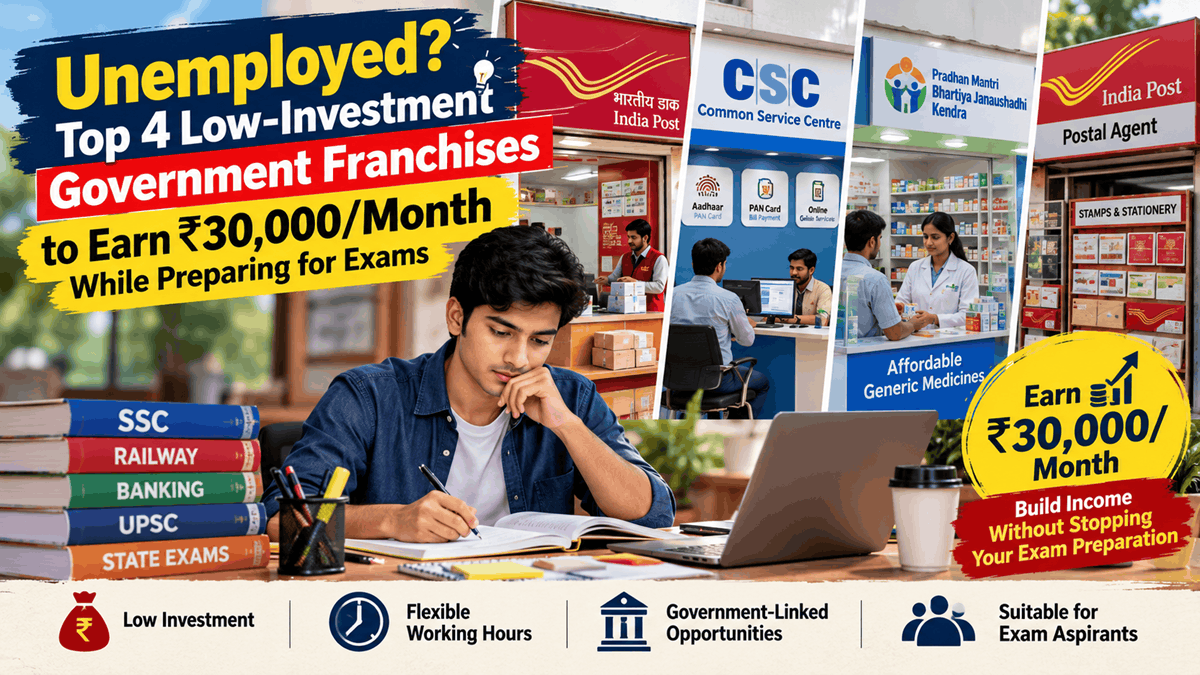
Are you unemployed and preparing for government exams such as SSC CGL, SSC CHSL, Railway, Banking, or state-level competitive examinations? If you need a source of income while studying, a small service business could be worth exploring.
India has several government-linked business opportunities that allow eligible individuals to provide postal services, access digital public services, sell affordable generic medicines, or distribute postal stationery. However, these opportunities differ significantly in their investment requirements, eligibility conditions, working hours, and income potential.
Can you earn ₹30,000 per month while preparing for exams? It may be possible, but no government franchise guarantees this income. Your actual earnings will depend on local demand, customer volume, applicable commissions, expenses, and the amount of time you can devote to the business.
In this guide, we examine four opportunities, explain their requirements, and show you what to verify before investing.
Quick Answer: Which Government-Linked Businesses Can You Explore?
| Opportunity | Main activity | Important consideration |
|---|---|---|
| India Post Franchise Outlet | Postal bookings and related counter services | Requires suitable premises, a security deposit, and regular operations |
| Common Service Centre (CSC) | Digital public and citizen services | Registration, service authorization, and local availability must be verified |
| Pradhan Mantri Bhartiya Janaushadhi Kendra | Retail sale of eligible generic medicines | Requires a qualified pharmacist, appropriate premises, licences, and working capital |
| India Post Postal Agent | Sale of postal stamps and stationery | Confirm the applicable appointment process and commission structure |
These are not four identical franchise models. CSC is a digital service-centre framework, Janaushadhi is a government-backed medicine retail scheme, and India Post has specific franchise and postal-agent arrangements.
1. India Post Franchise Outlet
An India Post Franchise Outlet is an opportunity to provide selected postal services through an approved counter outlet. The Department of Posts describes the scheme as a way to extend postal access in areas where opening a regular post office may not be feasible.
According to the official India Post Franchise Scheme, approved services can include booking Speed Post documents and parcels, India Post parcels, certain international postal articles, and other services assigned by the department.
What services can you offer?
Depending on your approved arrangement, services may include:
- Booking eligible Speed Post documents and parcels.
- Booking eligible retail postal parcels.
- Handling specified international postal bookings.
- Providing other authorized postal counter services.
The actual service list depends on the agreement and the arrangements with the linked post office.
Investment and eligibility
The official scheme document specifies a minimum security deposit of ₹5,000, which may be increased according to the financial transactions handled by the outlet. This is a security requirement, not the total cost of opening a business.
You may also need to budget for rent, a computer, internet connectivity, furniture, signage, and daily operating expenses.
The scheme document lists applicants above 18 years of age and a minimum educational qualification of Class 8, alongside premises, business-plan, and other selection requirements. Verify the current rules with the relevant postal division before applying.
Can you earn ₹30,000 per month?
There is no guaranteed monthly income. The franchise receives commission or remuneration according to the applicable terms. Actual profit depends on the number of postal transactions, local demand, operating costs, and the commission schedule.
Best suited for: Candidates who have access to a suitable shop or premises near a market, residential cluster, educational area, or business district and can arrange reliable daily staffing.
Official application information: India Post Franchise Scheme
2. Common Service Centre (CSC)
A Common Service Centre is a digital service delivery point that helps people access authorized government and other services, particularly where digital access or assistance is limited.
CSC centres operate under the Common Services Centres framework associated with the Digital India programme. Depending on authorization, service availability, and applicable rules, a centre may help customers with online applications, digital document-related services, bill payments, and other approved transactions.
What do you need to start?
A prospective Village Level Entrepreneur (VLE) should investigate the current onboarding and registration requirements before buying equipment or renting premises.
Common practical considerations include:
- A computer or laptop and a reliable internet connection.
- A suitable place to serve customers.
- The equipment required for the particular services offered.
- Identity, business, and other documents required by the applicable registration process.
- Separate authorization for any service that requires it.
Do not assume that registration automatically authorizes every service. Aadhaar-related services, banking services, insurance, and other regulated activities can have additional requirements.
How much can a CSC operator earn?
Income varies according to the services authorized, customer volume, applicable service charges or commissions, and operating expenses. There is no universal monthly salary or guaranteed ₹30,000 profit.
Before investing, check whether there is demand for digital assistance in your area and whether an existing CSC already serves the same customers.
Best suited for: Digitally confident candidates in areas where people need help accessing legitimate online services.
Official starting point: CSC Portal. Verify current registration availability and eligibility through the official channels.
3. Pradhan Mantri Bhartiya Janaushadhi Kendra
The Pradhan Mantri Bhartiya Janaushadhi Pariyojana (PMBJP) is a government initiative that promotes access to affordable generic medicines through dedicated retail outlets called Janaushadhi Kendras.
It differs from a small, part-time franchise because it is a medicine retail operation with specific licensing, staffing, premises, inventory, and customer-service responsibilities.
Who can open a Janaushadhi Kendra?
The official scheme information identifies individuals, proprietors, partnerships, eligible organizations, and certain other entities as possible applicants, subject to the applicable conditions.
Important requirements include:
- Suitable owned or leased premises.
- A qualified pharmacist with the required registration.
- A drug licence in the name of the Kendra.
- Sufficient funds to establish and operate the outlet.
- Compliance with the scheme’s product, stocking, and operational requirements.
A person who is not a qualified pharmacist may need to employ an eligible pharmacist. This adds to the business’s operating expenses.
What are the margins and incentives?
The PMBJP website states that the applicable retail margin is 20% of the maximum retail price, excluding taxes, on eligible products. It also describes a monthly purchase incentive effective from April 2026 of 12%, capped at ₹12,000, divided between a sales incentive and a stock incentive, subject to the applicable scheme conditions.
Certain eligible applicants or locations may qualify for a one-time special incentive of up to ₹2 lakh for specified infrastructure expenses. Eligibility and reimbursement conditions apply.
These figures should not be confused with take-home profit. Rent, salaries, inventory funding, electricity, and other operating expenses still need to be paid.
Can it work while preparing for exams?
Potentially, but it is not the most suitable option for someone who must personally study for several uninterrupted hours every day. A pharmacy retail outlet requires dependable staffing and proper handling of medicines.
Best suited for: Applicants with sufficient capital, access to a qualified pharmacist, a suitable location, and a plan for day-to-day management.
Official application: Apply for a Janaushadhi Kendra
4. India Post Postal Agent
India Post’s scheme documents also describe postal agents who sell postal stamps and stationery. This is distinct from operating a full franchise outlet with broader postal counter services.
For someone exploring a smaller business, a postal-agent arrangement may be worth investigating because the range of services can be narrower than that of a full franchise.
What can you do?
Depending on the current arrangement and appointment terms, the activity may involve selling authorized postal stamps and stationery to customers.
However, do not assume that every district is currently appointing new agents or that every postal-agent arrangement has identical terms.
What should you verify?
Before spending money, contact the relevant postal division and confirm:
- Whether new postal agents are being appointed.
- Which products you may sell.
- The current commission or remuneration structure.
- Whether a security deposit or other financial commitment applies.
- The permitted operating arrangement and documentation.
- Whether the opportunity can be combined with an existing shop or business.
Can it generate ₹30,000 monthly?
That depends on the applicable commission, the volume of sales, and the other products or services you are authorized to offer. Do not assume that postal-stationery sales alone will provide ₹30,000 in monthly profit.
Best suited for: People who already operate a small shop or have access to regular local customers, subject to the applicable appointment terms.
Official starting point: India Post
Comparison: Which Option Fits Your Budget and Schedule?
The following table compares the business models, not guaranteed returns.
| Factor | India Post Franchise | CSC | Janaushadhi Kendra | Postal Agent |
|---|---|---|---|---|
| Main requirement | Approved premises and operating funds | Equipment, onboarding and service authorization | Premises, pharmacist, licences and inventory | Appointment and authorized sales arrangement |
| Initial financial commitment | Deposit plus setup costs | Equipment and applicable setup costs | Generally substantial setup and working capital | Depends on current appointment terms |
| Can it be run part-time? | Only if operating and staffing requirements are met | Depends on service demand and operating arrangements | More difficult without reliable staff | Potentially, subject to applicable terms |
| Guaranteed ₹30,000 monthly profit? | No | No | No | No |
| Official starting point | India Post | CSC portal | PMBJP portal | India Post |
Important: Except for the minimum security deposit stated in the India Post franchise document, this article does not assign speculative investment figures to the opportunities. Get current written requirements and local quotations before preparing a budget.
How to Evaluate Whether ₹30,000 a Month Is Realistic
Start by distinguishing revenue, gross margin, and net profit.
Revenue is the total amount generated by the business. Gross margin is what remains after the direct cost of goods or services. Net profit is what remains after rent, wages, internet, electricity, transport, maintenance, and other operating expenses.
For example, if a hypothetical service business generates ₹45,000 in monthly revenue and has ₹18,000 in monthly expenses, its profit before any other applicable taxes or costs is ₹27,000.
This is an illustration, not an earnings forecast for any of the four opportunities.
Before making a decision, estimate:
- The average number of customers you can realistically serve each day.
- The actual commission or margin per transaction.
- Monthly rent, staffing, internet, electricity, and other expenses.
- The hours you must personally work.
- The amount of money you can afford to risk without borrowing beyond your repayment capacity.
If your business requires you to remain at the counter all day, the time cost may outweigh the financial benefit while you are preparing for a competitive examination.
How to Apply Safely
Use a verification-first process:
- Identify the relevant official scheme and read its latest guidelines.
- Confirm whether new applications are accepted in your district or proposed location.
- Obtain written details of eligibility, deposit, commission, operating hours, and required equipment.
- Estimate your total setup costs and working capital.
- Check whether you can manage the business without compromising your study schedule.
- Submit documents only through verified official channels or authorized offices.
- Keep receipts, application references, and copies of the signed agreement.
Never pay an agent who guarantees a government franchise, promises a fixed monthly income, or claims to have a secret quota of approvals.
FAQ Section
These FAQs target long-tail searches and common follow-up questions. Keep answers direct and update scheme-specific details when official rules change.
1. Which government franchise is best for unemployed youth?
India Post franchise outlets, Common Service Centres, Janaushadhi Kendras, and postal-agent arrangements are options to investigate. The right choice depends on your budget, eligibility, local demand, and available study time.
2. Can I earn ₹30,000 per month from a government franchise?
It is possible for some businesses, but no income of ₹30,000 per month is guaranteed. Calculate expected commissions, customer volume, operating expenses, and working hours before investing.
3. Which government business requires the least investment?
Investment varies by location and scheme. An India Post franchise has a documented minimum security deposit of ₹5,000, but that is not its total setup cost. Obtain current written requirements before comparing it with other options.
4. Can a student open a Common Service Centre?
A student may explore CSC registration if they meet the current eligibility and onboarding requirements. Service-specific authorization and local availability must also be checked.
5. Can I run a government franchise while preparing for SSC or Railway exams?
Yes, if the business’s operating requirements and staffing arrangements leave sufficient time for study. A counter business that requires your presence throughout the day may interfere with preparation.
6. Is the India Post franchise a government job?
No. It is a contractual business arrangement to provide approved postal services, not an appointment as a regular government employee.
7. What is the minimum security deposit for an India Post franchise?
The published India Post franchise scheme document specifies a minimum security deposit of ₹5,000. The actual required amount may be higher depending on the financial transactions handled.
8. Can I open a Janaushadhi Kendra without being a pharmacist?
An applicant who is not personally qualified may be able to apply by employing a pharmacist who meets the required qualifications and registration conditions. Drug licensing and other scheme requirements still apply.
9. Does the government guarantee profit from a franchise?
No. Government affiliation does not guarantee customers, revenue, or profit. The business owner bears the applicable operating costs and commercial risks.
10. Is a Janaushadhi Kendra suitable for a student with very little capital?
It may not be suitable. The business requires premises, qualified pharmacy staffing, licensing, inventory, and adequate working capital.
11. How do I apply for an India Post franchise?
Begin with the official India Post Franchise Scheme page and contact the relevant postal division for the current application process.
12. How do I apply for a Janaushadhi Kendra?
Review the current guidelines and application process on the official PMBJP application portal.
13. Is CSC registration the same as a government franchise?
Not exactly. CSC is a framework for delivering authorized digital services through service centres. Registration, authorization, and operating terms differ from a conventional franchise agreement.
14. Can I get a government subsidy to start a small business?
Some government programmes support eligible enterprises through credit-linked assistance or other benefits. Eligibility, permitted activities, application windows, and conditions vary. Verify the current scheme before including any subsidy in your budget.
15. Can I get a loan to start a franchise?
You can approach a bank or eligible financial institution, but approval is not automatic. Lenders assess the business, repayment capacity, documentation, and applicable lending criteria.
16. What documents may be required to open a government-linked service centre?
Depending on the scheme, requirements may include identity and address proof, PAN, bank details, educational documents, premises proof, business registration, licences, and other scheme-specific records.
17. How can I check whether a government franchise offer is genuine?
Verify the opportunity on the relevant department’s official website, contact the authorized office independently, and obtain the current terms in writing. Avoid payments to unofficial agents promising guaranteed approval or income.
18. Can I operate a franchise from home?
That depends on the scheme, approved premises, service requirements, and applicable local rules. Do not assume that a residential address is acceptable without written confirmation.
19. Should I take a loan to start a business while preparing for exams?
Borrowing can create financial pressure if the business takes longer than expected to become profitable. Estimate your break-even point, repayment obligations, and downside risk before committing.
20. What should I do before investing in a government franchise?
Confirm eligibility, verify that applications are open, obtain the official fee and commission details, estimate all setup costs, check local demand, and decide whether the operating schedule is compatible with your exam preparation.
Expert Insight: Protect Your Exam Preparation
The most important question is not simply which business can earn the most money. It is which business can cover your essential expenses without consuming the time you need to prepare for exams.
A business with high revenue can still be a poor choice if it requires long working hours, substantial borrowing, or constant personal supervision.
If you are unemployed and have limited savings, first validate local demand, calculate the break-even point, and investigate opportunities with lower fixed costs. Do not rent a shop, purchase stock, or take a loan merely because a scheme is government-backed.
The practical goal should be reliable income with manageable risk, not an unverified promise of ₹30,000 per month.
