
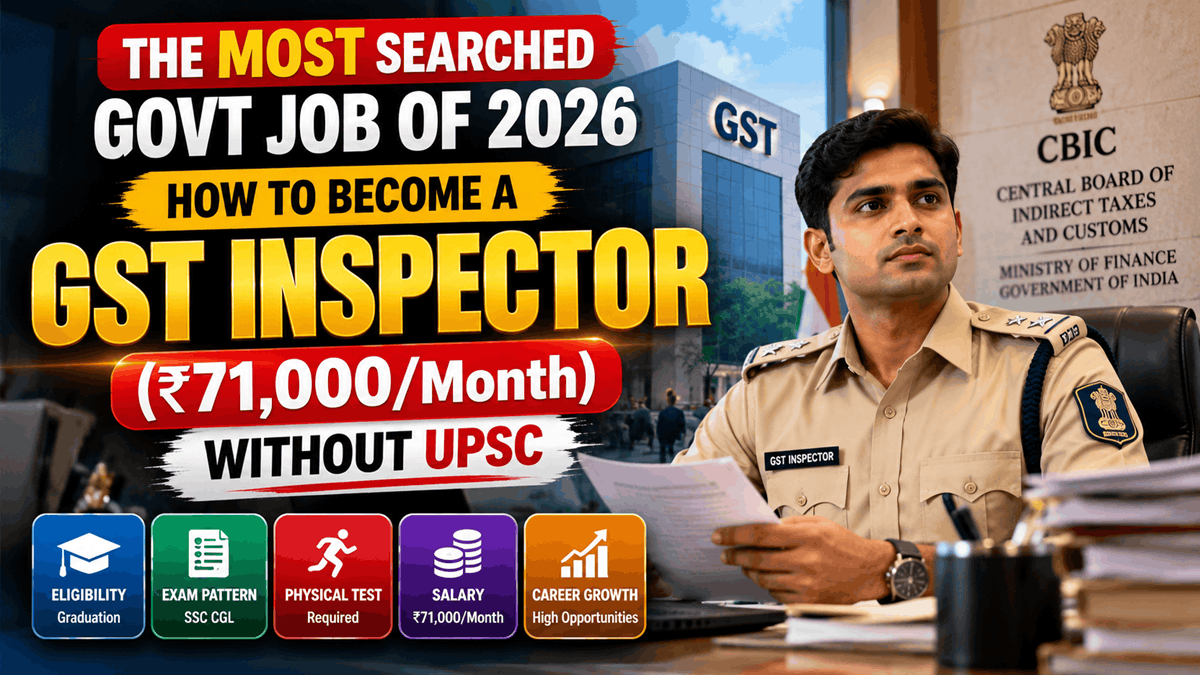
Imagine getting a Central Government Group B job, working in India’s indirect taxation department and earning a starting basic salary of ₹44,900 per month, without appearing for the UPSC Civil Services Examination.
This is the career opportunity offered by the GST Inspector post.
Many government-job aspirants assume that joining an important department under the Ministry of Finance requires clearing UPSC. However, becoming a GST Inspector follows a different recruitment route: the Staff Selection Commission Combined Graduate Level (SSC CGL) examination.
The post is officially listed as Inspector (Central Excise) under the Central Board of Indirect Taxes and Customs (CBIC).
In this guide, we explain the eligibility requirements, salary structure, physical test, examination pattern, responsibilities and preparation strategy.
Quick Answer: How to Become a GST Inspector?
To become a GST Inspector in India, you need to:
- Complete a bachelor’s degree from a recognised university.
- Meet the age requirements specified in the SSC CGL notification.
- Apply for the SSC Combined Graduate Level examination.
- Qualify SSC CGL Tier-I and Tier-II.
- Select Inspector (Central Excise), CBIC, in your post preferences.
- Clear the prescribed physical and medical standards.
- Complete document verification and appointment formalities.
You do not need to clear UPSC or hold a specialised GST degree.
What Is a GST Inspector?
A GST Inspector is a Central Government officer working under the Central Board of Indirect Taxes and Customs (CBIC), which operates under the Department of Revenue, Ministry of Finance.
CBIC is responsible for administering indirect taxes, including GST and customs duties.
The Inspector (Central Excise) post recruited through SSC CGL is commonly referred to as the GST Inspector because officers in this cadre perform Central GST-related responsibilities.
The distinction matters: SSC officially uses the designation Inspector (Central Excise), not a separately named GST Inspector recruitment examination.
What does a GST Inspector do?
The responsibilities can vary depending on the assigned formation, office and operational requirements.
Typical responsibilities include:
- Assisting in GST compliance and enforcement activities.
- Examining tax-related records and documentation.
- Supporting audits and verification activities.
- Collecting information about suspected tax evasion.
- Assisting investigations into fraudulent input tax credit claims.
- Supporting inspections and preventive functions.
- Processing departmental files and reports.
The CGST department’s published description of Inspector responsibilities includes preventive functions, audit-related activities and intelligence collection.
GST Inspector Salary 2026: Is ₹71,000 Per Month Possible?
Salary is one of the biggest reasons candidates consider this position.
The GST Inspector post comes under Pay Level 7 of the 7th Central Pay Commission.
Starting basic salary
₹44,900/month
Pay level
Level 7
Pay scale
₹44,900–₹1,42,400
Department
CBIC
Classification
Group B
Based on the SSC CGL 2026 notification. This is basic pay, not take-home salary. ssc.gov.in
GST Inspector salary breakdown
The monthly salary consists of several components:
| Salary component | Explanation |
|---|---|
| Basic Pay | Starting at ₹44,900 |
| Dearness Allowance (DA) | Based on the notified rate |
| House Rent Allowance (HRA) | Depends on city classification and accommodation rules |
| Transport Allowance | Depends on applicable entitlement |
| NPS contribution | Applicable pension deduction |
| Other deductions | As applicable |
The Department of Expenditure notified DA at 60% of basic pay with effect from 1 January 2026. DEPARTMENT OF Expenditure
The actual take-home salary depends on the posting city, applicable allowances, pension deductions and taxation.
Is ₹71,000 in-hand salary realistic?
It can be a reasonable indicative figure for some salary calculations, but it should not be advertised as a guaranteed salary for every newly appointed Inspector. Some postings and allowance combinations can result in a higher amount.
For accurate salary calculations, candidates should use the applicable government allowance orders and their actual posting details.
GST Inspector Eligibility Criteria 2026
Candidates must satisfy the educational qualification, age and other eligibility requirements specified in the SSC CGL notification.
1. Educational qualification
The minimum educational qualification is:
- Bachelor’s degree from a recognised university or equivalent.
- Candidates from any recognised academic stream can apply.
- Final-year graduation candidates can apply only if they obtain the required qualification by the notification’s prescribed date.
For SSC CGL 2026, the essential qualification had to be possessed by 1 August 2026. ssc.gov.in
2. Age limit
For Inspector (Central Excise), the prescribed age limit in SSC CGL 2026 is 18–30 years, calculated as on 1 August 2026.
| Category | Upper-age relaxation |
|---|---|
| General | No relaxation |
| OBC | 3 years |
| SC/ST | 5 years |
| PwBD | 10 years |
| PwBD (OBC) | 13 years |
| PwBD (SC/ST) | 15 years |
Other applicable relaxations are governed by the official notification. ssc.gov.in
GST Inspector Physical Test 2026
This is an important eligibility condition that many aspirants overlook.
Unlike certain other SSC CGL posts, Inspector (Central Excise) under CBIC has physical standards and efficiency requirements.
Physical requirements for male candidates
| Requirement | Standard |
|---|---|
| Minimum height | 157.5 cm |
| Chest | 81 cm |
| Chest expansion | Minimum 5 cm |
| Walking | 1,600 metres in 15 minutes |
| Cycling | 8 km in 30 minutes |
Physical requirements for female candidates
| Requirement | Standard |
|---|---|
| Minimum height | 152 cm |
| Minimum weight | 48 kg |
| Walking | 1 km in 20 minutes |
| Cycling | 3 km in 25 minutes |
Relaxations are available for specified categories and regions under the notification.
Important: The physical and medical assessments are conducted by the concerned department after selection. SSC also warns candidates to check post-specific requirements before submitting their preferences. Failing the relevant standards can affect appointment to the allotted post.
How to Become a GST Inspector Without UPSC: Complete Selection Process
The recruitment route is SSC CGL.
GST Inspector selection pathway
- GraduationComplete a recognised bachelor’s degree.
- SSC CGL applicationRegister and apply through the official SSC portal.
- Tier-I examinationQualify the computer-based preliminary screening examination.
- Tier-II examinationAppear for the applicable papers and qualify the required sections.
- Post preference and meritSelect Inspector (Central Excise), CBIC, and secure the required merit position.
- Physical and medical assessmentMeet the prescribed departmental standards.
- Document verification and appointmentComplete the remaining recruitment formalities.
SSC CGL Tier-I examination pattern
The Tier-I examination consists of four subjects.
| Subject | Questions | Marks |
|---|---|---|
| General Intelligence and Reasoning | 25 | 50 |
| General Awareness | 25 | 50 |
| Quantitative Aptitude | 25 | 50 |
| English Comprehension | 25 | 50 |
| Total | 100 | 200 |
- Examination duration: 60 minutes.
- Negative marking: 0.50 marks for each incorrect answer.
- Examination mode: Computer-based test.
SSC CGL Tier-II examination
Tier-II is the decisive stage for final merit for the Inspector (Central Excise) post.
Paper-I includes:
- Mathematical Abilities
- Reasoning and General Intelligence
- English Language and Comprehension
- General Awareness
- Computer Knowledge Test
- Data Entry Speed Test (DEST)
Candidates must qualify the required sections. For posts other than specified specialist posts, final merit is prepared using the prescribed Paper-I merit components. ssc.gov.in+1
SSC CGL 2026: Important dates
The official SSC CGL 2026 notification provides the following schedule:
| Event | Date |
|---|---|
| Notification | 21 May 2026 |
| Application start | 21 May 2026 |
| Application deadline | 22 June 2026 |
| Tier-I examination | August–September 2026 (tentative) |
| Tier-II examination | December 2026 (tentative) |
Current application status: The SSC CGL 2026 application window has closed. Candidates who missed it should prepare for the next recruitment cycle and monitor the official SSC website for announcements. The examination dates in the original notification were tentative. ssc.gov.in
Official notification: Download SSC CGL 2026 official notification.
Official recruitment portal: Staff Selection Commission.
GST Inspector Syllabus: What Should You Study?
Aspirants should prepare across four core academic areas and the additional Tier-II requirements.
| Subject | Important topics |
|---|---|
| Quantitative Aptitude | Percentage, ratio, profit and loss, algebra, geometry, time and work |
| Reasoning | Coding-decoding, analogy, series, puzzles, classification |
| English | Grammar, vocabulary, comprehension, error detection |
| General Awareness | History, geography, polity, economics, science, current affairs |
| Computer Knowledge | Computer fundamentals, internet, cybersecurity, office applications |
Which subjects deserve the most attention?
Do not prepare every subject with equal intensity regardless of your performance.
- If mathematics is weak, build calculation speed and accuracy.
- If English is weak, practise comprehension and grammar daily.
- If reasoning is strong, focus on solving questions within time limits.
- For General Awareness, combine static GK with current affairs.
The objective is not simply to finish the syllabus. It is to achieve a competitive score while avoiding unnecessary negative marking.
GST Inspector Job Profile: What Happens After Selection?
The actual job is more than collecting taxes.
Depending on the posting, an Inspector may work in administrative, audit, preventive, intelligence or enforcement-related functions.
Some important responsibilities include:
1. GST compliance monitoring
Assisting departmental officers in examining taxpayer compliance and identifying discrepancies.
2. Audit assistance
Supporting audit teams in examining business records, tax payments and relevant documentation.
3. Tax evasion investigation
Collecting information and assisting investigations into suspected GST evasion and fraudulent transactions.
4. Input Tax Credit verification
Assisting in identifying irregular or potentially fraudulent Input Tax Credit (ITC) claims.
5. Departmental reporting
Preparing reports, processing files and supporting supervisory officers.
6. Field inspections
Participating in inspections and other field activities as assigned.
The work profile is not identical across every CGST commissionerate. Your responsibilities depend on the formation, assignment and supervisory structure.
GST Inspector Promotion and Career Growth
The GST Inspector position offers opportunities for departmental advancement.
A commonly discussed career progression is:
- Inspector (Central Excise)Entry-level post through SSC CGL.
- SuperintendentHigher supervisory responsibilities.
- Assistant CommissionerHigher-level administrative and departmental responsibilities, subject to applicable promotion rules.
- Deputy Commissioner and aboveFurther advancement subject to cadre rules, vacancies, eligibility and service requirements.
Illustrative career progression, not a guaranteed promotion timeline. Promotion pathways and eligibility are governed by applicable CBIC cadre rules.
Promotion speed can vary significantly. Candidates should not assume that a particular designation will be achieved after a fixed number of years.
GST Inspector vs Income Tax Inspector: Which Is Different?
Both positions are recruited through SSC CGL and come under the Ministry of Finance.
However, their departments and taxation responsibilities differ.
| Factor | GST Inspector | Income Tax Inspector |
|---|---|---|
| Department | CBIC | CBDT |
| Tax category | Indirect taxation | Direct taxation |
| Recruitment exam | SSC CGL | SSC CGL |
| Pay level | Level 7 | Level 7 |
| Starting basic pay | ₹44,900 | ₹44,900 |
| Primary area | GST and Central Excise-related work | Income tax administration |
| Physical requirements | Applicable | No equivalent CBIC Inspector physical test |
Both are Group B posts. Their actual work environments, postings and responsibilities differ.
How to Prepare for GST Inspector Through SSC CGL
Getting the job requires more than knowing the GST Act. The recruitment examination tests mathematics, reasoning, English, general awareness and computer knowledge.
Here is a practical preparation strategy.
Step 1: Understand the SSC CGL syllabus
Download the official notification and understand the Tier-I and Tier-II examination structure.
Avoid preparing using outdated examination patterns.
Step 2: Build subject-wise preparation
Divide your preparation into four main areas:
- Mathematics: Calculation, arithmetic and advanced mathematics.
- Reasoning: Logical reasoning and problem-solving.
- English: Grammar, comprehension and vocabulary.
- General Awareness: Static GK, current affairs and general science.
Step 3: Practise previous-year questions
Previous-year papers help you understand question difficulty, recurring concepts and time management.
Step 4: Attempt mock examinations
Take full-length mock tests and analyse your mistakes.
Track:
- Accuracy percentage.
- Questions attempted.
- Time spent per question.
- Subject-wise performance.
- Repeated mistakes.
Step 5: Prepare for the physical test early
Do not wait until the written examination results to start physical preparation.
Candidates targeting the CBIC Inspector posts should check their height, weight and chest measurements, where applicable, and gradually develop the walking and cycling endurance required by the notification.
Step 6: Fill post preferences carefully
This is particularly important.
SSC allocates posts based on merit and candidate preferences. If you select a CBIC Inspector post without meeting its physical requirements, your candidature may be rejected for that post.
Do not select a post simply because its salary or designation looks attractive.
6. Frequently Asked Questions (FAQs)
1. Can I become a GST Inspector without UPSC?
Yes. You can become a GST Inspector by qualifying SSC CGL. UPSC Civil Services is not the recruitment examination for this post.
2. What is the salary of a GST Inspector in 2026?
The starting basic salary is ₹44,900 per month under Pay Level 7. Gross and in-hand salary vary according to allowances, posting location and deductions.
3. Is GST Inspector a Group B job?
Yes. Inspector (Central Excise) under CBIC is classified as a Group B post in the SSC CGL 2026 notification.
4. What is the qualification for GST Inspector?
A bachelor’s degree from a recognised university or equivalent is required.
5. Can a BA graduate become a GST Inspector?
Yes. Candidates with BA, BCom, BSc, BBA, BCA, engineering and other recognised bachelor’s degrees can apply, subject to the applicable notification requirements.
6. Is mathematics compulsory for GST Inspector?
Mathematics is part of the SSC CGL examination. However, you do not need to hold a mathematics degree.
7. Is there a physical test for GST Inspector?
Yes. The CBIC Inspector (Central Excise) post has prescribed physical standards and walking and cycling tests.
8. What is the height requirement for male GST Inspector candidates?
The prescribed minimum height is 157.5 cm, with specified relaxations for eligible categories.
9. What is the height requirement for female GST Inspector candidates?
The prescribed minimum height is 152 cm, with applicable regional relaxations.
10. Can female candidates become GST Inspectors?
Yes. Female candidates are eligible, subject to the SSC CGL eligibility conditions and applicable physical standards.
11. What is the age limit for GST Inspector in SSC CGL 2026?
The age limit is 18–30 years as on 1 August 2026, with applicable category-wise relaxations.
12. Is GST Inspector a permanent government job?
The post is a regular Central Government recruitment position. Appointment and service conditions are subject to applicable government rules and probation requirements.
13. Is GST Inspector recruited directly by CBIC?
Direct recruitment to this Inspector cadre is conducted through SSC CGL, with CBIC as the user department.
14. Is GST Inspector more powerful than Income Tax Inspector?
They have different statutory responsibilities and departmental jurisdictions. Neither designation automatically has greater authority in every situation.
15. Can a 12th-pass student become a GST Inspector?
Not directly. A bachelor’s degree is required. A 12th-pass student can pursue graduation and prepare for SSC CGL alongside it.
16. What is the promotion after GST Inspector?
The commonly discussed next promotional position is Superintendent, followed by higher departmental positions subject to applicable rules and vacancies.
17. Is GST Inspector a desk job or field job?
It can involve both. The nature of work depends on the assigned CGST formation and responsibilities.
18. Can I choose my posting location?
Candidates provide post preferences, but the final allocation and posting depend on merit, vacancies, administrative requirements and departmental allocation rules. A preferred city is not guaranteed.
19. Is GST Inspector the same as Central Excise Inspector?
In the SSC CGL context, the commonly used term GST Inspector generally refers to Inspector (Central Excise) under CBIC. The official recruitment designation remains Inspector (Central Excise).
20. Can I apply for SSC CGL 2026 now?
The original application window closed on 22 June 2026. Candidates who did not apply should monitor SSC announcements for the next recruitment cycle.
