
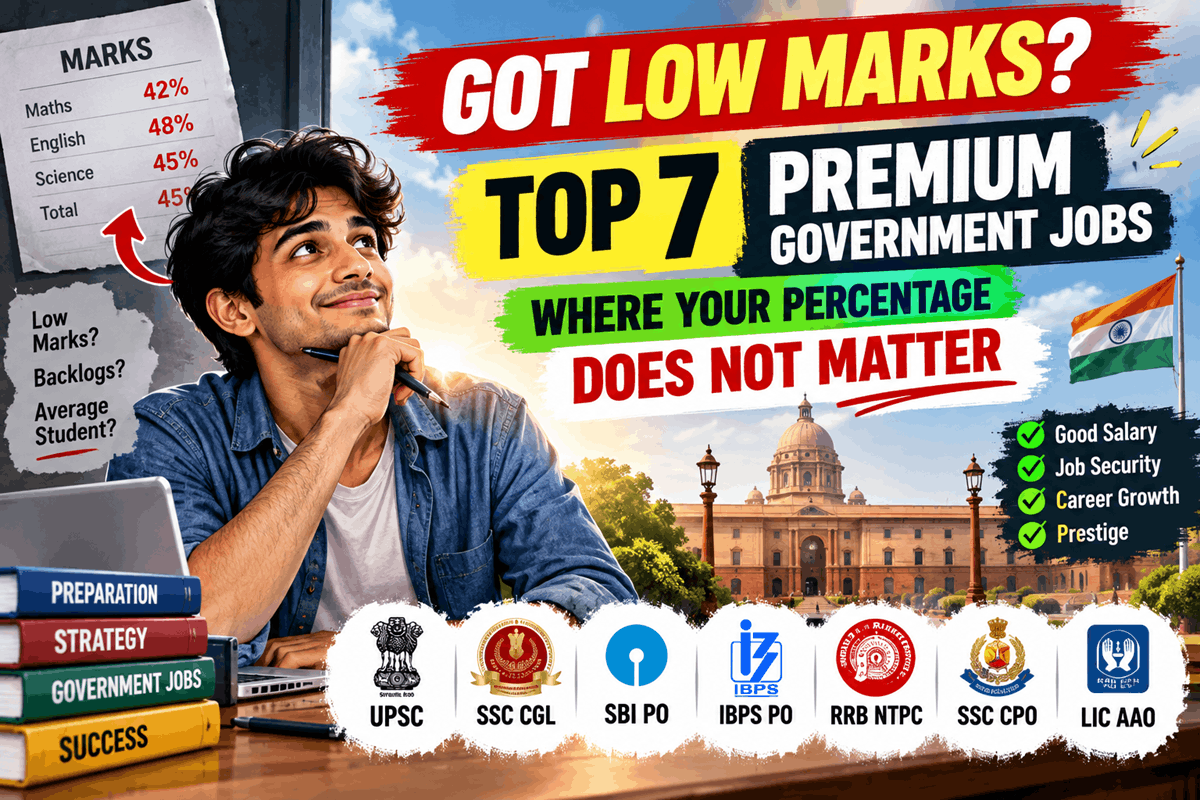
Scored low in college and worried that your marks have already ruined your chances of getting a government job?
Not necessarily.
Many government recruitment examinations do not use a minimum graduation percentage as their basic eligibility requirement. Instead, they require you to possess a recognized degree and then compete through an examination, skill test, interview, physical test or another selection stage, depending on the post.
That creates an important opportunity for graduates who don’t have 60%, 70% or 80% marks.
But there is a catch: “percentage does not matter” does not mean your marks are completely irrelevant in every recruitment. Some examinations have minimum academic percentages, and some specialized posts have additional educational requirements.
Here are seven major recruitment routes worth knowing about.
What Does “Percentage Does Not Matter” Actually Mean?
When we say that percentage does not matter for a particular recruitment, we mean that the recruitment notification does not prescribe a minimum graduation percentage as part of the basic eligibility for that post.
For example, a recruitment may say:
Bachelor’s degree from a recognized university.
It does not necessarily say:
Bachelor’s degree with at least 60%.
That distinction is important.
You may still have to enter your graduation percentage in the application form. Some recruiting organizations collect the information for administrative purposes even when they do not set a minimum percentage threshold.
So don’t confuse:
“No minimum percentage requirement”
with:
“Your academic percentage is never requested.”
Those are two different things.
Top 7 Government Jobs Where Graduation Percentage May Not Be the Barrier
1. UPSC Civil Services Examination
If your graduation marks are low, the UPSC Civil Services Examination is one of the most important examinations to investigate.
The Civil Services Examination is the recruitment route associated with services such as the IAS, IPS, Indian Revenue Service and other Central Government services.
For the 2026 examination, the educational qualification is a graduate degree from a recognized university or an equivalent qualification. The eligibility rule does not prescribe a general minimum percentage in graduation.
That means a candidate should not assume that a low graduation percentage automatically prevents them from appearing for the Civil Services Examination.
However, UPSC is not an easy shortcut for students with low marks.
Your college percentage may not be the main barrier, but the examination itself is highly competitive and includes Preliminary Examination, Main Examination and Personality Test stages.
Best suited for: Graduates who are prepared for a long-term, highly competitive examination.
2. SSC CGL
The Staff Selection Commission Combined Graduate Level Examination, commonly called SSC CGL, is another major option.
The 2026 SSC CGL notification lists numerous Group B and Group C posts across Central Government ministries, departments and organizations.
For most CGL posts, the basic educational requirement is a Bachelor’s degree from a recognized university or equivalent.
The important exception is that certain specialized posts have additional requirements.
For example, the Junior Statistical Officer has additional mathematics/statistics-related eligibility requirements.
Therefore, don’t read “SSC CGL” as one single qualification rule for every post.
For the majority of general graduate-level posts, however, the basic requirement is a recognized bachelor’s degree rather than a stated 60% graduation threshold.
Why SSC CGL is worth considering
SSC CGL can lead to posts such as:
- Assistant Section Officer
- Income Tax Inspector
- Assistant Enforcement Officer
- Sub-Inspector
- Inspector-level positions
- Auditor
- Accountant
- Tax Assistant
The 2026 notification lists posts across Pay Levels 4 through 8, including Group B and Group C positions.
Best suited for: Graduates who want Central Government recruitment and prefer an exam-focused route.
3. SBI Probationary Officer
Think your low graduation percentage automatically disqualifies you from becoming a bank officer?
Not necessarily.
The State Bank of India Probationary Officer recruitment requires a graduate degree in any discipline from a recognized university or an equivalent qualification recognized by the Central Government.
The eligibility information does not prescribe a general minimum graduation percentage.
However, SBI asks candidates to provide their graduation percentage during the application process.
That’s an important distinction.
Your percentage may be recorded, but that does not automatically mean that you need 60% or another specified minimum percentage to satisfy the basic educational qualification.
SBI PO selection involves multiple stages, including:
- Preliminary Examination
- Main Examination
- Group Exercise/Interview
The final selection is based on the applicable recruitment process rather than simply your college percentage.
Best suited for: Graduates interested in banking, management and officer-level careers.
4. IBPS Probationary Officer / Management Trainee
The IBPS PO/MT recruitment is another major option for graduates.
The 2025 IBPS PO/MT-XV notification specifies a degree in any discipline from a recognized university or an equivalent qualification.
Importantly, the notification requires candidates to provide their graduation percentage during registration, but the cited educational qualification does not impose a general minimum graduation percentage.
This makes IBPS PO particularly relevant for candidates who think:
“I have a degree, but my percentage is not good enough for banking.”
The real challenge is clearing the recruitment stages.
Candidates should prepare for the applicable:
- Preliminary examination
- Main examination
- Personality/assessment stages where applicable
- Interview/selection process as specified in the recruitment cycle
As always, the exact recruitment notification for the year you apply should be treated as the final authority.
Best suited for: Graduates targeting public-sector bank officer recruitment.
5. RRB NTPC Graduate-Level Posts
Indian Railways is another major area for graduates who are concerned about their academic percentage.
The Railway Recruitment Boards conduct recruitment for Non-Technical Popular Categories (NTPC) posts.
The RRB NTPC Graduate recruitment includes several graduate-level positions, with eligibility determined according to the individual post.
Examples can include roles such as:
- Chief Commercial cum Ticket Supervisor
- Station Master
- Goods Train Manager
- Junior Account Assistant cum Typist
- Senior Clerk cum Typist
The critical point is that candidates must check the educational requirement for the particular post in the relevant RRB notification.
Railway recruitment can also include post-specific requirements such as typing tests, aptitude tests, medical standards or other conditions.
So while low graduation percentage may not automatically eliminate you from relevant graduate-level posts, post-specific eligibility still matters.
Best suited for: Graduates interested in Railway careers and large-scale competitive recruitment.
6. SSC CPO / Sub-Inspector
Want a government job in policing or investigation but have a low graduation percentage?
The SSC Central Police Organization examination is another route to investigate.
The SSC CPO recruitment covers Sub-Inspector positions in organizations including Delhi Police and the Central Armed Police Forces, subject to the applicable recruitment notification.
The 2025 SSC CPO notification states the essential educational qualification for the posts as a Bachelor’s degree from a recognized university or equivalent.
It does not prescribe a general minimum graduation percentage in that educational qualification.
But this examination has an important difference from a purely desk-based graduate examination.
Candidates must satisfy the applicable:
- Physical Standard Test
- Physical Endurance Test
- Medical requirements
- Computer-based examination
- Other recruitment conditions
Therefore, a low academic percentage may not be your biggest obstacle—but physical eligibility can become a decisive requirement.
Best suited for: Graduates interested in police, investigation and uniformed government roles.
7. LIC Assistant Administrative Officer — Generalist
The Life Insurance Corporation of India Assistant Administrative Officer (AAO-Generalist) is another premium officer-level recruitment route worth watching.
LIC’s 2025 AAO Generalist notification required:
A Bachelor’s Degree in any discipline from a recognized Indian University/Institution.
The notification did not specify a minimum graduation percentage for the Generalist educational qualification.
The 2025 recruitment had 350 AAO Generalist vacancies.
LIC also specified a structured selection process involving:
- Preliminary Examination
- Main Examination
- Interview
- Pre-recruitment medical examination
The 2025 notification stated a basic pay of ₹88,635 per month and approximately ₹1.26 lakh monthly total emoluments at the minimum of the scale in an A-class city, subject to the stated allowances and conditions.
This makes AAO Generalist an important recruitment to monitor when LIC announces future vacancies.
Best suited for: Graduates looking for an officer-level career in insurance and financial services.
Quick Comparison: Government Jobs for Low-Percentage Graduates
| Recruitment | Basic Degree Requirement | General Minimum Graduation % in Cited Notification? | Other Major Requirements |
|---|---|---|---|
| UPSC Civil Services | Graduate degree | No | Prelims, Mains, Personality Test |
| SSC CGL | Bachelor’s degree for most posts | No general minimum | Post-specific requirements |
| SBI PO | Graduation in any discipline | No general minimum | Prelims, Mains, interview/group exercise |
| IBPS PO/MT | Graduation in any discipline | No general minimum | Competitive recruitment stages |
| RRB NTPC Graduate | Graduate qualification according to post | Post-specific | CBT, skill/aptitude/medical requirements depending on post |
| SSC CPO | Bachelor’s degree | No general minimum | CBT + physical/medical requirements |
| LIC AAO Generalist | Bachelor’s degree in any discipline | No | Prelims + Mains + Interview + medical |
Important: This table describes the cited recruitment notifications and should not be treated as a permanent rule. Recruitment authorities can change eligibility conditions from one recruitment cycle to another.
Which Government Jobs May Still Require a Minimum Percentage?
This is where many articles on this subject become misleading.
Not every government job ignores academic percentage.
For example, RBI Grade B General in the 2026 notification requires a minimum of 60% in graduation, with specified relaxation for SC/ST/PwBD candidates, or an alternative postgraduate qualification with specified marks.
Therefore, someone with low graduation marks should not simply search for “government jobs” and assume they are eligible for every competitive examination.
Instead, classify opportunities into two groups:
Group A: Degree-based eligibility
These are recruitment processes where the notification primarily requires possession of a recognized degree.
Group B: Percentage-based eligibility
These specifically require a minimum percentage, such as 50%, 55%, 60% or another prescribed threshold.
Your strategy should focus more heavily on Group A opportunities if your academic percentage is low.
Does Your Class 10 or 12 Percentage Matter?
It depends on the recruitment.
A government recruitment notification may specify requirements for:
- Class 10
- Class 12
- Diploma
- Graduation
- Post-graduation
- Professional qualifications
Never assume that because graduation percentage is not specified, Class 10 or Class 12 percentage automatically doesn’t matter.
Always check the exact educational qualification section of the latest notification.
This is particularly important for specialized posts.
What Actually Determines Your Selection?
Here’s the uncomfortable truth:
Low graduation marks may not be stopping you. Lack of preparation might be.
If the recruitment does not prescribe a minimum graduation percentage, your energy should shift away from worrying about an old marksheet and toward the selection stages you can actually control.
Depending on the examination, these can include:
- Quantitative aptitude
- Reasoning
- English
- General awareness
- Current affairs
- General studies
- Subject-specific knowledge
- Descriptive writing
- Interview performance
- Physical fitness
- Typing speed
- Computer skills
Your graduation percentage is already on your marksheet.
You cannot change it.
Your examination preparation, however, is still under your control.
How to Choose the Right Exam If You Have Low Marks
Don’t apply randomly to every recruitment notification.
Start with your eligibility.
If you want administrative/central government roles
Look at:
SSC CGL + UPSC Civil Services
If you want banking
Look at:
SBI PO + IBPS PO/MT
If you want Railways
Look at:
RRB NTPC Graduate recruitment
If you want police/investigation
Look at:
SSC CPO
If you want insurance/financial services
Monitor:
LIC AAO
Then compare:
- Age limit
- Educational qualification
- Number of vacancies
- Exam pattern
- Number of stages
- Physical requirements
- Posting conditions
- Salary structure
- Promotion structure
- Competition
- Your own strengths
FAQ Section
1. Can I get a government job with 40% graduation marks?
Yes, potentially. Several major recruitment examinations do not prescribe a general minimum graduation percentage, but you must check the specific post and notification.
2. Which government jobs don’t require 60% graduation?
Examples include SSC CGL general graduate posts, UPSC Civil Services, SBI PO, IBPS PO/MT and SSC CPO under the cited notifications. LIC AAO Generalist also did not specify a minimum graduation percentage in its 2025 notification.
3. Can I apply for SSC CGL with 45%?
For most CGL posts, the general educational requirement is a bachelor’s degree or equivalent. Specialized posts can have additional requirements.
4. Can I become an IAS officer with low graduation marks?
The UPSC Civil Services Examination requires a recognized graduate degree but does not prescribe a general minimum graduation percentage in the 2026 eligibility rules.
5. Does SBI PO require 60% in graduation?
The SBI PO eligibility information specifies graduation in any discipline but does not state a general 60% graduation requirement. Candidates nevertheless have to provide their graduation information as required by the application.
6. Does IBPS PO require 60%?
The cited IBPS PO/MT XV notification requires graduation in any discipline and asks candidates to report their graduation percentage, but does not prescribe a general 60% minimum.
7. Does percentage matter for every government job?
No. Eligibility rules differ substantially by recruitment and post. Some recruitments specify minimum academic percentages.
8. Is RBI Grade B suitable for someone with low graduation marks?
The 2026 RBI Grade B General eligibility requires 60% in graduation, with specified relaxation for SC/ST/PwBD candidates. Therefore, it should not be presented as a general low-percentage option.
9. Can low marks stop me from getting a bank job?
Not necessarily. Some bank recruitments use degree-based eligibility rather than a minimum graduation percentage. SBI PO and IBPS PO are examples under the cited recruitment rules.
10. Do I still need to enter my graduation percentage?
Sometimes, yes. For example, SBI and IBPS require candidates to provide graduation percentage information even where the cited eligibility does not impose a general minimum percentage.
11. Does SSC CPO require a minimum graduation percentage?
The cited 2025 SSC CPO notification specifies a bachelor’s degree or equivalent rather than a general minimum graduation percentage. Other physical and recruitment requirements apply.
12. Does LIC AAO Generalist require 60%?
The 2025 LIC AAO Generalist notification specifies a bachelor’s degree in any discipline from a recognized Indian university/institution and does not state a minimum percentage for that qualification.
13. Can final-year students apply?
This depends on the recruitment. Several examinations permit final-year candidates subject to obtaining the required qualification by the specified cutoff date. Always check the current notification.
14. Is a low Class 12 percentage also acceptable?
It depends on the recruitment. Some examinations focus on graduation, while others prescribe Class 10/12 requirements for particular posts.
15. Does CGPA count as percentage?
Recruitment authorities may specify how CGPA/OGPA should be converted. Follow the conversion method in the applicable notification.
16. Which is better for low-mark graduates: SSC CGL or banking?
There is no universal answer. Compare the eligibility requirements, exam pattern, job role, posting conditions and your strengths rather than choosing solely because of your percentage.
17. Can I apply for government jobs after a distance-learning degree?
Potentially, if the degree and institution satisfy the recognition requirements applicable to the recruitment. The exact notification should be checked.
18. Does government selection depend on college marks?
Not always. In many competitive examinations, selection is based on the recruitment examination and subsequent selection stages. However, eligibility rules differ by examination.
The Bottom Line
Getting low marks in graduation does not automatically end your government-job ambitions.
Several major competitive recruitment routes are based on possessing a recognized degree rather than achieving a specified minimum graduation percentage.
Among the important options are:
UPSC Civil Services, SSC CGL, SBI PO, IBPS PO/MT, RRB NTPC Graduate posts, SSC CPO and LIC AAO Generalist.
But don’t make the opposite mistake and assume your percentage is irrelevant everywhere.
Recruitment rules vary.
Some posts require minimum percentages. Some require specific subjects. Some require physical standards. Others have skill tests or professional qualifications.
So the smarter strategy is simple:
Don’t ask, “Is my percentage good enough for government jobs?” Ask, “Which government recruitment notifications accept my exact educational profile?”
That question gives you an actionable path forward.
